• Skip to main content
  • Skip to footer

Apprenticeships for Growth

How Skills Investment Can Drive Australia's Economy

  • WPC Group
  • NextGen Jobs
  • Shake a Leg
  • Connect

Nicholas Wyman

Conversation around the Skills Needs of Employers

WINA Morning News With Rick And Jane on WINA-AM 1070  |  13 May, 2015  |
Virginia needs to fill 1.5 million jobs in the next decade. Most will require post-secondary education (but less than a Bachelor’s Degree).
Nicholas Wyman and Jane Foy discuss the critical role that community colleges play in addressing the skills needs of Virginia’s businesses into the 21st century.

wina-wp-hero


Listen to the Interview here:

http://iwsiaustralia.org/wp-content/uploads/2015/05/Nick_Wyman_Interview_13_May_NewRadio_1070_WINA_Charlottesville_VA.mp3

Filed Under: Radio

Apprenticeships help build Upstate ‘skills hub’

by Robbie Ward | Upstate Business Journal | 7 May 2015

Programs give real-world experience to tomorrow’s workers

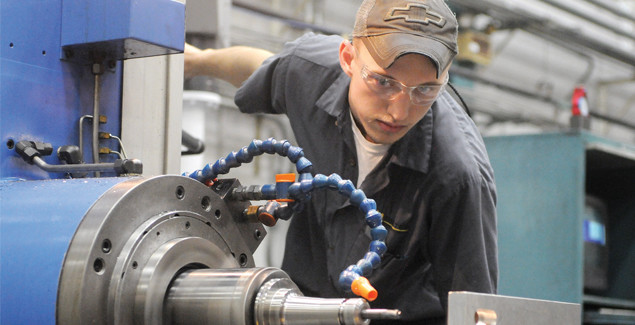
Blue Ridge High School senior Travis Tate wakes most mornings at 5:30, early enough to arrive at United Tool and Mold, where he participates in a nationally recognized model for high-skill employee recruitment and development.

Apprenticeships_Cover51815-635x325

The Taylors resident operates industrial equipment while other students slap snooze buttons on their alarm clocks. He continues working most days after his fellow students have left school to return home.
Like his father and older brother before him, Tate, 17, plans a career in the high-skilled labor field and started early as part of the youth apprenticeship program at the Upstate industrial supplier support company.
“Here you see what activity happens in the real world,” he said recently, taking a break inside United Tool and Mold’s Duncan facility. “This is the industry I’d like to be in.”
A few high-tech computerized machines away on the shop floor, Rickey Hooper, 46, facility manager for the Duncan location, explained the value of young apprentices nearly 30 years his junior learning the trade. He learned in a similar way as a high school senior in 1986.
“In our trade, it’s hard to go out and find skilled labor that we need because we’re so specialized,” he said. “We can get young workers and train them to be what we need.”
The company has 12 apprentices total at the Easley and Duncan operations. Two years out of high school, employees who complete youth and adult apprenticeships can earn about $43,000 annually.

Nationwide attention

United Tool and Mold may not have the household-name status of companies like Michelin, BMW and other larger corporate players in the Upstate. However, the company’s apprenticeship programs have received an impressive amount of national media attention from news organizations including Bloomberg News, The New York Times, PBS NewsHour, CNN and National Public Radio.

Apprenticeships_chart3
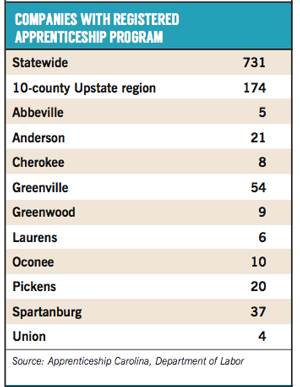
Thanks to Apprenticeship Carolina, a South Carolina Technical College System program launched in 2007, the number of companies with registered apprenticeship programs has skyrocketed. When the program started, South Carolina had about 90 participating companies, a tiny fraction of the 728 with apprenticeships registered in the Palmetto State as of early April.
State and federally registered apprenticeship programs have three parts: on-the-job training, job-specific education and a plan to increase workers’ wages as they progress through their apprenticeships. South Carolina companies receive tax credits of $1,000 per employee apprentice, renewable for up to four years while the apprenticeship continues.
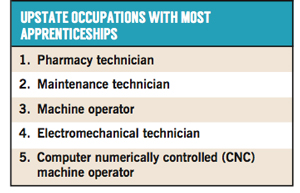
Companies can register apprenticeships among 1,061 different occupations, ranging from an accordion maker to an X-ray equipment tester. The fields with the most apprenticeships in the Upstate include pharmacy technician, maintenance technician, machine operator, electromechanical technician, computer numerically controlled machine operator, machinist and electrician.
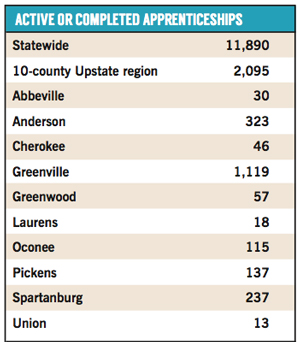
Nearly a quarter of the state’s companies with apprenticeship programs operate in the Upstate region of Abbeville, Anderson, Cherokee, Greenville, Greenwood, Laurens, Oconee, Pickens, Spartanburg and Union counties. Apprenticeship Carolina data shows 2,095 people who have completed or currently enrolled in apprenticeship programs. Statewide, the number climbs to 11,890.

‘A demand and supply that makes it work’

Nicholas Wyman, CEO of the New York-based Institute for Workplace Skills and Innovation, has traveled internationally to learn about the success of apprenticeships in throughout the world. His book, “Job U,” published in January by Random House, examines the intersection between unfilled jobs, people looking for work and the need for more high-skilled job training. His research for the book took him to the Upstate.
Wyman considers South Carolina, particularly the Upstate region, a national model for apprenticeships, thanks to collaborative partnerships among economic development, government, industry, kindergarten through high school and technical college leadership.

Apprenticeships_chart2
“People outside of the United States regard South Carolina as one of the leading states related to apprenticeships and what could be accomplished,” he told UBJ. “You’ve got a demand and a supply that makes it work.”
Apprenticeship Carolina works with each company to create an apprenticeship program with educational curriculum catered to specific needs. Carla Whitlock, Apprenticeship Carolina consultant for the Upstate, said the organization within the state technical college system completes paperwork on behalf of companies interested in starting apprenticeship programs. This removes worries for companies concerned about mounting red tape or spending lots of time completing related documents.
“That’s one of the things that makes Apprenticeship Carolina so successful,” Whitlock said. “We take away the burden of paperwork from the company.”
Apprenticeships_2
Experience first

Cynthia Eason, vice president for corporate and economic development at Greenville Tech, said partnerships throughout the region help individuals acquire more attractive job skills, help employers attract and retain higher-skilled workers, and generally increase the wealth and overall quality of life in the region.
“No matter the job, you want employees to have experience before they’re turned loose doing it,” Eason said. “This is a great way to do that.” She anticipates more job apprenticeships in the region in information technology and health care fields based on job-sector growth.
State and federal data exists for registered apprenticeships; however, many more job training and workforce development programs exist to train new and current employees. For instance, at General Electric’s gas turbine manufacturing facility in Greenville, the company has co-op and apprenticeship programs associated with Greenville Technical College but not registered with the state.
Spartanburg native Ron Lowery, 38, served in the Marine Corps and then worked as a maintenance mechanic before starting a co-op with GE in January 2014. He took wielding and fabricating classes at Greenville Tech while also working at industrial employer during the week.
Five months later, Lowery has a full-time job at GE. Appreciating the time with seasoned employees as he learned his trade, the welder said the company has earned his loyalty; however, the co-op ending didn’t stop his learning.

Apprenticeships_chart
“Everyday I still ask plenty of questions and try to learn what I can,” he said. “I feel like the sky is the limit.”
Another veteran, Malcolm Fuller, 32, who served in Iraq during his time in the Navy, expects to complete a machine tool technologies apprenticeship at GE in this month. He said he feels grateful for the opportunity to simultaneously learn and work for the company.
“They really encourage you to go further with your education,” he said.

Skills hub of the future

As the state and Upstate continue to find distinction for developing employees from within, Wyman – the apprenticeship researcher, advocate and author – believes the effort will help attract more high-skilled jobs and employers.
“I think in five to 10 years we’re going to see this part of South Carolina known as the skills hub when other areas aren’t prepared for these skills changes,” said Wyman, who has a MBA from Harvard Business School.
Back at United Tool and Mold, production administration manager Jeromy Arnett said he and other leaders at the company approach apprenticeships as critical to bridging current success to the future.
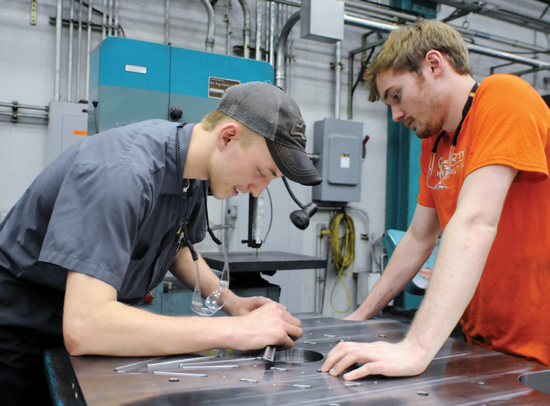
“We have to get that tacit or tribal knowledge passed from one generation to the next,” he said. “You do that by pairing the older workers with the younger ones.”
Travis Tate, one of the company’s apprentices, said he looks forward to a career with the company.
“They’re giving me the opportunity I wouldn’t have if they weren’t here,” he said. “I highly appreciate and respect that.”


upstatebusinessjournal - logo
Online article location:
http://upstatebusinessjournal.com/news/apprenticeships-help-build-upstate-skills-hub/


Filed Under: Articles

Matching Jobless with Jobs

There’s a lot of people looking for work at the same time that there’s a worker shortage. Information Morning speaks with Nicholas Wyman to get some ideas on how to fix this mismatch.

Addressing the growing gap between the skills employers are looking for and the qualifications Canada’s young people are receiving, IWSI CEO Nicholas Wyman is in town to speak at the Halifax Chamber of Commerce Spring Dinner. He shares his innovative ideas on how this skills gap can be addressed.

Listen to the interview here:

http://iwsiaustralia.org/wp-content/uploads/2015/05/NICK-INTERVIEW-1-5-15-cbc-nova-scotia-mono.mp3

Filed Under: Radio

A Toolkit To Close Skilled Labour Gap

by Nicholas Wyman.

To prepare an informed, competitive workforce for today’s economy, it’s critical to emphasize skills development and create clear pathways for job-seekers.

Working against this idea is Nova Scotia’s current reality.

Today, 1.3 million Canadians are unemployed, while around 230,000 positions remain unfilled. This is not to mention the hundreds of thousands of workers in sectors that are in a state of underemployment. Many of these people are working in jobs that are not representative of the skills they have or could easily gain.

Why? Because businesses can’t find people with the skills they need to get the job done.

The Now or Never report published by Ray Ivany said Nova Scotia fares well in comparison with other provinces in terms of workforce education and training. Over half of Nova Scotia’s workforce meets the “skilled” test: they are working with a trade certificate or college or university education.

This rate is better than the Canadian average. But considering that Nova Scotia had 44,000 people looking for work in 2014, with 5,100 job vacancies at the time, being above average is still not good enough. And these figures do not include local underemployment — the really hard-to-measure “skilled worker, working in an unskilled position.” What can be done to close the gap?

First, review the school curriculum. Upgrade the qualifications that young people can get while they are still in high school. By forging strong partnerships between educators and industry, you ensure that students graduate with the right skills and experience to transition directly into high-demand careers.

Second, strengthen literacy, numeracy and practical skills. It is important to engage young adults through a dynamic and modern curriculum that builds up essential skills like communication, problem-solving, and critical thinking — the skills employers seek.

Third, government and communities need to develop education and training strategies that keep pace with global and technological change — and forge partnerships with business.

Fourth, businesses need to maintain a long-term commitment to skills. Investing in apprenticeship programs and opportunities for employees to upskill allows employers to cultivate their human capital, ensuring their future workforce and competitive advantage.

Fifth, raise the status of skills. Culturally, we can raise the esteem of vocational pathways so that young adults see skills training as an option for the labour force.

For job-seekers, the current demand for skills offers exciting opportunities to launch well-paying, respected careers in a wide variety of industries, without taking on student loan debt. It’s understood that actions like curriculum changes cannot happen overnight. But what might be misunderstood are the changes that business can enact now.

Businesses that employ skilled workers should consider having a skills-building program, directed by a straightforward approach that includes:

•Designing apprenticeships or training around the company’s business needs. These programs shouldn’t be about charity, but about creating value for the enterprise.

•Offering attractive pay to apprentices and offering each of them a “career ladder” to more challenging and better paying positions.

•Assigning a mentor to each participant. An effective mentor transfers valuable organizational knowledge while providing support and guidance. Young adults and their mentors develop bonds of loyalty that lead to employee satisfaction and retention.

•Giving a “hand up” through skills-building is a powerful way for managers to help their organizations while addressing nagging social and economic problems.

Businesses in regions like South Carolina and Manchester, U.K., institutionalized these kinds of changes, and they have paid off very well. Besides, it’s an excellent way to do well by doing good. And in Nova Scotia, it must be now.

chronicleheraldlogo

Online Article location:
http://thechronicleherald.ca/opinion/1282527-a-toolkit-to-close-skilled-labour-gap#

Filed Under: Articles

Getting 9.1 million Americans to work

By Dante A. Disparte and Nicholas Wyman  |  April 21, 2015


The nation is facing a grave problem that threatens the economic future of every worker, every company, and the country at large. Over 9.1 million Americans are unemployed and millions of others are underemployed. Yet, 4.8 million jobs remain unfilled because there are not enough people with the practical, real-world skills that companies need. The current skills gap is not only hampering domestic growth; it’s threatening economic competitiveness on a global scale. The more insidious aspect of this employment trend is that many in the workforce are giving up the very attribute that makes the U.S. great – hope.
We know that we need skilled people to close this gap. We know that behind every successful economy you find an engaged and productive workforce. We also know that the cost of living is rising and even the minimum wage, for most people, is not enough to get by. And we know that by the end of this decade that one in three jobs will require some higher education. Our education system doesn’t give enough weight to practical and technical skills, to the hands-on learning that informs the real-world skills that companies actually need. At the core of this challenge, of course, is educational access and affordability. With U.S. student loan debt reaching $1.2 trillion dollars, and the average 4-year college graduate leaving school saddled with $30,000 in debt, things simply must change. Left unchecked, student loan debt may very well produce the next systemic financial crisis.walkingtowork
All complex challenges have multi-stage solutions. In this case, much of the work that needs to be done to get the nation back to work is qualitative. For example, destigmatizing the trades and vocational skills is a great place to start. Along these lines, President Obama’s program to make community college free, while maintaining a B grade point average, does a lot to improve general educational access. However, it’s the demand-side of the employment market, namely the firms doing the hiring, that undervalues the trades. There are so many jobs and career pathways in the U.S. economy that are filled by algorithm. That is to say “no B.A. or M.B.A., no job.”  Yet, in reality, willing and able people, regardless of their educational attainment, can fill all but the most complex jobs in our economy. In fact, the rise of corporate universities and Starbuck’s groundbreaking college access program suggests that firms want their raw human capital inputs to be measured by personal determinants, such as cultural fit, adaptability and other ‘untrained’ traits. The rest of their ‘formal’ education can be attained on the job or, in Starbuck’s case, through the job.
The global job market is changing profoundly and many hitherto ‘safe’ career classes, including in the services space, run the risk of being automated, dislocated or disrupted altogether. While the U.S. remains a global hotbed of entrepreneurship, the lack of professional apprenticeships is troubling. In Europe, an apprenticeship is not only a coveted position, it is a vital pathway for skills transfer, career advancement and a long term footing in the middle class. Unlike its U.S. cousin the internship, an apprentice is rarely found doing menial, low value-added work. Rather, apprentices are most often found gaining practical skills, often at senior echelons over an extended period of time. This work, based in the end on cultural fit, often translates into career options with the hiring firm. In some companies, such as the Danish firm Kjaer Group, successful apprentices were not only rewarded with a job, they scaled Mount Kilimanjaro with the company’s CEO.
Against this backdrop, there are 3 broad recommendations to address the nation’s unemployment and underemployment challenges. The first involves fixing educational attainment and affordability. When compared to OECD countries, America’s prohibitively high student debt burden not only inhibits risk-taking at ages where people can bounce back, it quite literally is a drag on the economy leading many young people to bankruptcy and lifelong financial problems. Many studies are now questioning the economic rationale and ROI for all but the most technical fields in tertiary education. The second broad recommendation, ironically, involves lowering barriers to workplace entry, rather than raising them. Importing European-styled apprenticeships can materially reduce the unemployment rate, give the underemployed new hope and create a vital source of talent for firms struggling to fill key positions.  Finally, “buy-side” improvements by hiring firms that break algorithmically safe hiring patterns can serve as a catalyst for change in the U.S. job market. With these recommendations in place, vitality and resilience will be restored in the U.S. workforce.
Disparte is the founder and CEO of Risk Cooperative and the chair of the Business Council for American Security. Wyman is the CEO of the Institute for Workplace Skills and Innovation and author of Job U, a best-selling book on upskilling the workforce.

thehill_logo_200

 View the original article here:
  http://thehill.com/blogs/congress-blog/labor/239471-getting-91-million-americans-to-work

Filed Under: Uncategorized

  • « Go to Previous Page
  • Page 1
  • Interim pages omitted …
  • Page 14
  • Page 15
  • Page 16
  • Page 17
  • Page 18
  • Interim pages omitted …
  • Page 25
  • Go to Next Page »

Footer

Publications

‘Job U: Find Your Path To A Successful Carer in a Tough Job Market’
by Nicholas Wyman

‘Job U – How to Find Wealth and Success by Developing the Skills Companies Actually Need‘  (US Edition) quickly shot to #1 on the Amazon Hot New Releases in Job Hunting and Career Guides. It has been awarded Best Business Careers book in the International Book Awards and won USA Best Book Awards, Business: Careers category.

Get ready to relearn everything you thought you knew about what a successful career path looks like.

Visit JOB U

  • WPC Group
  • NextGen Jobs
  • Shake a Leg
  • Connect

Copyright © 2026 IWSI Australia