• Skip to main content
  • Skip to footer

Apprenticeships for Growth

How Skills Investment Can Drive Australia's Economy

  • WPC Group
  • NextGen Jobs
  • Shake a Leg
  • Connect

Nicholas Wyman

‘New STEM Education Model to Develop Australia’s Most Valuable Resource’ – Huffington Post, Online


Download PDF

Australia is a land abundant in natural resources: iron ore, coal, diamonds, gold, and oil and gas. It is so flush with natural resources it is central to the Nations mythology: the country ‘rode on the sheep’s back’ as ‘the lucky country’. Although Australia enjoyed a continuously growing economy and relatively low unemployment for the past 20 years, the global financial crisis wiped out a quarter of a million jobs down under, and many parts of the mining industry are feeling the effects of a post- resources boom. As a result, unemployment among young people has skyrocketed, forcing the nation to confront the fact that for its luck to continue it must develop more than its mineral and energy resources, it must develop its most valuable resources of all: its human capital.


Read more


Source: http://huff.to/2peqW4m

Filed Under: Uncategorized

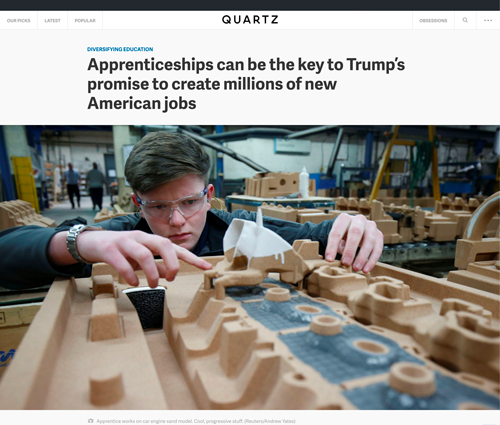
‘Apprenticeships can be the key to Trump’s promise to create millions of new American jobs’ – Qz, Online

By Nicholas Wyman, 29 April 2017

At the recent White House roundtable discussion on vocational education attended by president Trump and German chancellor Angela Merkel, Marc Benioff, chairman and CEO of Salesforce, called on the President to “take a moonshot goal to create 5 million apprenticeships in the next five years.”

Download PDF

Given the president campaigned on a promise to deliver 25 million new jobs over the next 10 years, Beinoff’s go big or go home attitude was perfectly pitched for his audience. In response Trump readily agreed, stating “let’s do that, let’s go for that 5 million.”

That statement pricked up the ears of vocational training advocates across the country who have been hoping his administration will seize the untapped growth potential for apprenticeship programs in this country, and issue an official announcement soon. The time is right to pursue a Benioff’s goal, which could potentially offer a myriad of new opportunities to millions of Americans to have better, fulfilling careers, whilst making a significant down payment on the President’s 25 million jobs promise.

While we have been getting used to regular good news on the labor front, with over 450,000 new hires across January and February, with unemployment near nine year lows at 4.7% and the economy inching towards full employment, these figures mask two chronic, nagging problems.

The first is persistently high youth joblessness—a consequence of too many young people completing high school (and college) without gathering meaningful work experience or marketable skills. US youth unemployment is around 10% percent nationally, and twice that in many urban areas. The second problem is of employers who are unable to find people with the skill set required to get the job done—the “skills gap” is harder to measure, but it is conservatively estimated that upwards of 5.9 million jobs are currently unfilled.

The power of apprenticeship programs in reducing youth unemployment and narrowing the skills gap by creating custom skilled workers has long been demonstrated in northern Europe, where this centuries-old form of learning remains strong and enjoys both business and societal support. (Germany’s leadership in this domain was the key reason for Merkel’s attendance.)

There, the majority of high school students graduate with substantial vocational training and work experience under their belts. Of those who do not go directly to university, a large percentage enter apprenticeship programs, which are widely available across many industries. The transition between the world of school and the world of work is much more integrated than what we typically witness here in the US. Apprenticeship programs provide these young people with the skills they require to get and keep well-paying jobs, and businesses get to access the skilled workers they require.

An apprentice is an employee who earns as they learn, both on the job and, in a community college or tech school classroom. Learning under the guidance of an experienced tradesperson, the apprentice masters a valuable and often highly paid occupation. Several years of hands-on learning equips the worker with exactly the skills and experience they will need for a productive work life and career. As an approach to making people employable and boosting the skilled labor supply, the apprenticeship model delivers the greatest bang for the buck.

The term apprentice however still conjures up images from earlier times, of a young person in a leather apron making barrels, hand-looming cloth, silver smithing, or shaping a red-hot piece of iron on an anvil. However, if that’s what pops into your mind, think again.

Twenty-first century apprenticeships are more sophisticated and progressive, and are found in modern fields beyond the blue collar such as IT and cyber security, advanced manufacturing, energy, construction, healthcare, transport and logistics and hospitality. Indeed, many of today’s most attractive knowledge economy jobs can be learned through apprenticeships.
One of the great strengths of an apprenticeship is the unique relationship it creates between mentor and learner. This multigenerational ‘pay it forward’ relationship is more personal and interactive than anything we find in the academic world of professors. Apprentices do not sit passively in lecture halls. Instead, they engage in active exchanges that involve diagnosing problems, forming and testing opinions, receiving direct feedback and collaborating on solutions. These experiences develop the apprentice’s workplace sophistication, maturity, sense of accountability, and problem-solving power—virtues that benefit both apprentice and employer.

So how could the Trump administration begin to tackle Benioff’s ‘moonshot’ target of 5 million apprentices? One way would be to better reallocate existing dollars from ineffective academic only programs to apprenticeship and other cost-effective strategies which directly deal with identified skill mismatches and shortages at a local level. With this reallocated funding, the government should seek to provide market-targeted incentives to private training organizations, community colleges, state and local agencies to market and provide financial support for the rapid nationwide expansion of apprenticeships.

Apprenticeships offer a solid bridge between school and the world of work, attack the root causes of youth unemployment, and create a pathway to successful and rewarding careers.

It’s time. Apprenticeship has never been more relevant, or more necessary.

Source:

https://qz.com/943818/apprenticeships-can-be-the-key-to-trumps-promise-to-create-millions-of-new-american-jobs/


Filed Under: Articles Tagged With: 'Apprenticeships can be the key to Trump’s promise to create millions of new American jobs' - Qz, Online

‘Why 5 Million Apprenticeships Will Make America Great Again’ – Forbes, Online

by Nicholas Wyman.

Download PDF

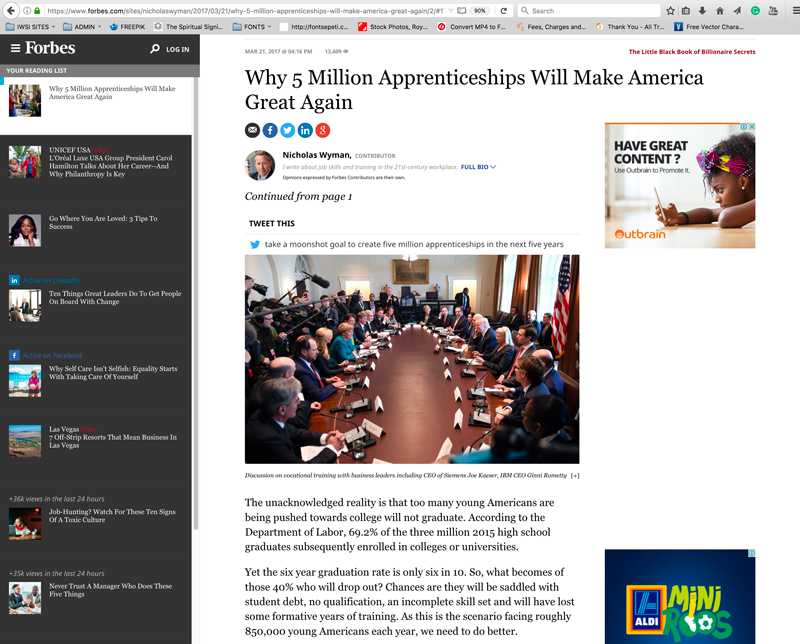
The White House roundtable last week has shone a spotlight on the countries job, skills and training needs for the 21st century workplace. With German Chancellor Angela Merkel and leading American and German industrial CEOs seated at the Cabinet table, President Donald Trump praised Germany’s long-term approach in using on apprenticeships programs to develop its workforce’ skills, declaring “The German apprenticeship model is one of the proven programs to developing a highly skilled workforce. Germany has been amazing at this.”

The U.S., he stated, must embrace innovation in technical and vocational education and explore effective non-college approaches, like apprenticeships to prepare people for the trade, manufacturing and other well-paying careers of the future.

And its easy to understand why: Germany, despite having the highest wage costs in the world, has a significantly lower unemployment (4.2%) and youth unemployment (6.5%) rate than the U.S. (4.9% and 9.9%) or any other comparable country. It also has a an export economy focused high-value manufacturing: last last year Germany lodged a record trade current account deficit of U.S. $297 billion – nearly 8.5% of GDP – and runs strong budget surpluses.

As these enviable economic outcomes are substantively underpinned by Germany’s commitment to wide and varied apprenticeship training pathways, it was no surprise to hear CEO after CEO outline how their firm’s approaches to expanding vocational pathways and call for the expansion of apprenticeship programs in the U.S.

Marc Benioff, chairman and CEO of Salesforce, even encouraged the president to “take a moonshot goal to create five million apprenticeships in the next five years.”

The president’s response “let’s do that, let’s go for that five million” was mightily encouraging to apprenticeship advocates across the nation.

Image: In Germany, vocational training is ingrained in the education culture. Apprentices learn the basics of precision filing at the Siemens training center, Berlin. (Photo by Sean Gallup/Getty Images)

A target of five million apprenticeships, may seem a significant stretch as the U.S. currently has just on 500,000 active apprentice positions, however, a unified approach to expanding this mode of training would not also generate improved economic and employment conditions for our citizens, but also put a big dent into several related social and budgetary problems, for example:

• Closing the “skills gap” that is acting as a handbrake on business investment in capacity expansion in the U.S. A shortage of skilled job candidates regularly tops of list of CEO complaints.

• High youth joblessness and underemployment. Millions are unemployed or stuck in low-wage, temporary jobs, with little hope of moving up. Apprenticeships will help people avoid a range of poverty and welfare traps.

• Stagnant wages. Wages stagnate when productivity fails to grow. Apprenticeships turn out workers trained to the cutting edge of industry, to ensure maximum productivity. (Most newly minted apprentices pull down starting pay from $45,000 to $60,000, out-earning the majority of their bachelor degree peers).

Yet despite knowledge of the benefits and superior outcomes generated by German and other European vocational training systems, only a small percentage of U.S. high school graduates enter apprenticeships, compared to their counterparts in some high-income EU countries.

Why is that? Blame could be reasonably apportioned onto many heads: high schools that have eliminated vocation education; some counselors and parents who think that the only pathway to a successful and rewarding career runs through a four-year college degree; and a job snobbery, where many in society look down their nose at careers that involve making or fixing things. On the front line, its more a chicken-egg problem. There are far too few apprenticeship offers from companies for many schools and counselors to pay much attention.

The unacknowledged reality is that too many young Americans are being pushed towards college will not graduate. According to the Department of Labor, 69.2% of the three million 2015 high school graduates subsequently enrolled in colleges or universities.

Yet the six year graduation rate is only six in 10. So, what becomes of those 40% who will drop out? Chances are they will be saddled with student debt, no qualification, an incomplete skill set and will have lost some formative years of training. As this is the scenario facing roughly 850,000 young Americans each year, we need to do better.

So, in the wake of the big White House skills roundtable, what can business leaders and the Trump administration do to rapidly scale up apprenticeships? Here are three easy to achieve suggestions:

1. Redirect tax dollars from ineffective government job-training programs and weak academic programs to incentives that encourage private companies to offer more apprenticeships.

2. Establish a major marketing effort to promote apprenticeships and to make apprenticeships more straightforward to create.

3. Insist that major contractors on federally funded infrastructure projects incorporate apprentices in their work crews.

Encouragingly, there are many great and inspiring examples of apprenticeship programs (and apprentices!) which gives me hope that we can close our skills gaps.

To deliver on his promises to create 25 million new jobs in ten years, recreate industrial America and bring back U.S. manufacturing, it is clear the president should grasp Marc Benioff’s “moonshoot” suggestion, set an ambitious target of five million apprentices in five years.

The result be would be a significant down payment on the president’s 25 million jobs target, the expansion of the most cost-effective skills training model across America and as well as positively impacting the lives of potential millions of people along the way.

That’s the thing about shooting for the moon – even if you miss, you’ll land among the stars!

Link:
https://www.forbes.com/sites/nicholaswyman/2017/03/21/why-5-million-apprenticeships-will-make-america-great-again/#6a8223c22fce

Filed Under: Articles Tagged With: ‘Why 5 Million Apprenticeships Will Make America Great Again’ - Forbes, Forbes, Online

‘Don’t go to college for career advice’ – Salon.com, Online

Download PDF

Massive college debt is a hot-button issue these days. I sat down with Nick Wyman, the CEO of the Institute for Workplace Skills and Innovation and author of “Job U,” to discuss how to better prepare Americans for their future careers.

“Really what happened is we suddenly had this massive amount of people going to college, a lot of people were dropping out of college, people are taking on student loans,” Wyman said during our Salon Talks.

According to the U.S. Census, more than 20 percent of people 18 to 34 years old live in poverty in America today. This is an uptick from how Baby Boomers lived in the 1980s, with millennials earning an average of $2,000 less today than young adults did back then, even though they are more likely to have a college degree.

Wyman argued that this cycle is bad for our workforce and bad for our country — he’s worried that we’re inadequately preparing our young people for the workforce.

“So you have people exiting the education system without the skills that employers need, and that caused all sorts of problems,” Wyman said.

Source:
http://www.salon.com/2017/03/03/watch-dont-go-to-college-for-career-advice-cautions-workplace-skills-expert/

Filed Under: Articles, Video

‘The Lowdown on CTE Down Under’ – Techniques Magazine, USA

Download PDF

For more than a century, vocational education and training (VET), as career and technical education (CTE) is known as in Aus­tralia, has been a core tenet of workforce development for the country’s traditional­ly and heavily industry-centered economy.
Respected internationally as a leading exponent of integrated and responsive training, Australia’s VET sector has prov­en its ability to be adaptive and agile in supporting government priorities to establish young people in the workforce, while working with industry to develop future-focused skills training packages. Despite its comparative maturity, the Australian VET sector is tackling many of the same pressures and issues as the United States, including skill shortages, hesitant employers, digital disruption pains and current training curriculum, all while trying to improve accountability. To understand how Australia has developed and is adapting. We asked a few of the country’s thought leaders to identify the current key concerns “at the coalface.”

Techniques Magazine, USA

Filed Under: Articles

  • « Go to Previous Page
  • Page 1
  • Interim pages omitted …
  • Page 4
  • Page 5
  • Page 6
  • Page 7
  • Page 8
  • Interim pages omitted …
  • Page 25
  • Go to Next Page »

Footer

Publications

‘Job U: Find Your Path To A Successful Carer in a Tough Job Market’
by Nicholas Wyman

‘Job U – How to Find Wealth and Success by Developing the Skills Companies Actually Need‘  (US Edition) quickly shot to #1 on the Amazon Hot New Releases in Job Hunting and Career Guides. It has been awarded Best Business Careers book in the International Book Awards and won USA Best Book Awards, Business: Careers category.

Get ready to relearn everything you thought you knew about what a successful career path looks like.

Visit JOB U

  • WPC Group
  • NextGen Jobs
  • Shake a Leg
  • Connect

Copyright © 2026 IWSI Australia