• Skip to main content
  • Skip to footer

Apprenticeships for Growth

How Skills Investment Can Drive Australia's Economy

  • WPC Group
  • NextGen Jobs
  • Shake a Leg
  • Connect

IWSI Australia

‘Time to Work: Why US Is Ready to Expand Modern Apprenticeships’ – Newsmax

By Nicholas Wyman – Tuesday, 14 January.

Read on Newmax Finance

Something’s happening in the U.S. economy right now. And it’s mostly good – business expansion, low unemployment, tightening labor markets, rising stock market prices and record profit shares. But underneath all the good news is a fundamental workforce problem. Companies want to grow – they have the means and the market to grow – but they can’t find skilled workers.

That’s right – there are a lot of jobs, and a lot of people looking for jobs. But there’s a mismatch between the skills jobseekers have and skills employers need. In some cases, companies have to put off expansion plans because of this mismatch. Entire communities might find themselves unable to attract and retain businesses because of this mismatch. There’s a siren going off and we need to pay attention.

Why is this happening? One reason is that our system for developing talent is out of synch with employer needs. Workplaces are changing rapidly. New technology is eliminating a certain class of jobs – those that consist of repetitive tasks or processes. But it’s creating another class of jobs – those who maintain, manage and program new technology. In other words, people who can work with technology are in demand.

Working with technology requires a different skill set than has been traditionally taught in high school and college. More than ever, prospective workers need technical skills – they need to know how to run the machines, robots and programs that increasingly make up the modern workplace.

But there’s more to it than that. Modern workers need to be tinkerers and problem-solvers. They need to know how to ask questions, when and how to get help, how to work in teams and communicate effectively with both machines and their co-workers. This is a skill set not typically obtained with a traditional four-year college degree.

What’s the answer? For many years now, I’ve been promoting apprenticeship, and I believe now is the right time for a system of modern apprenticeship in the U.S. When I say modern apprenticeship, I mean a system that goes beyond the traditional trades (though those are still a great way to get skills that lead to well-paying jobs) and branches out to all sectors, including finance, healthcare, tech, hospitality, and green sciences. Pretty much any expanding business sector can use modern apprenticeship to get the skilled workforce it needs.

Apprenticeships have several key components that benefit both employees and employers. Employees get customized classroom and on-the-job training while earning a wage. They get guidance and feedback from workplace mentors to maximize the benefits of their on-the-job learning and experience. And those that complete the apprenticeship successfully get a nationally recognized credential (for Registered Apprenticeships) and usually some credit towards an associate’s or bachelor’s degree.

Meanwhile, employers get trained employees with skills that match the job roles they need now and in the future. Many companies have also found that apprenticeship programs increase employee loyalty, engagement and productivity (for both apprentices and their mentors). And some companies are using apprenticeships specifically to diversify their workforce – with positive effects for both the business and the community.

Apprenticeships aren’t magic. But they are a proven system for developing a skilled workforce precisely suited to employer needs. Other highly successful economies have been using an apprenticeship system for years (Switzerland, Australia, the UK). Now it’s our time. In fact, many prominent American companies are already investing in apprenticeship, including LinkedIn, Lockheed Martin, JP Morgan Chase, Amazon, Adobe and Mailchimp.

Now is the right time to start an apprenticeship program. The federal government is investing hundreds of millions of dollars in apprenticeship – funds that are available to private sector employers, local and state governments and nonprofits that want to initiate or ramp up an apprenticeship program.

Forward-thinking businesses and communities will certainly take advantage of that funding, and all that apprenticeship has to offer. It’s time to become one of them.

Read on Newmax Finance

Filed Under: Articles

‘Closing The Skills Gap With Apprenticeship: Costs Vs. Benefits’ – Forbes


By Nicholas Wyman.

Forbes
Modern Apprenticeships are available in a broad range of 21st-century industries and occupations. Photo: Getty

In my previous post I talked about the “buy or build” choice for closing the skills gap. Do you compete in a tight labor market (buy); or train new workers yourself (build)?

In this post I review the costs and benefits of the latter option—building a skilled workforce with an apprenticeship program.

First, let’s review some of the benefits of apprenticeship:

  • apprenticeship develops highly skilled employees suited to the unique requirements of your workplace;
  • apprenticeship leads to innovation at the host firm;
  • apprenticeship lowers long-term recruitment and training costs;
  • only a small percentage of apprentices go elsewhere after they complete training.

But how can you measure these kinds of benefits? Good question. Costs are a bit more straightforward. Employers can easily estimate the cost of apprentice wages and fringe benefits over several years, as well as the cost of classroom training. You can also get a reliable cost estimate for the time mentors (or job coaches) spend with apprentices. Measuring benefits is more challenging, owing to the difficulty of measuring apprentice productivity over several years.

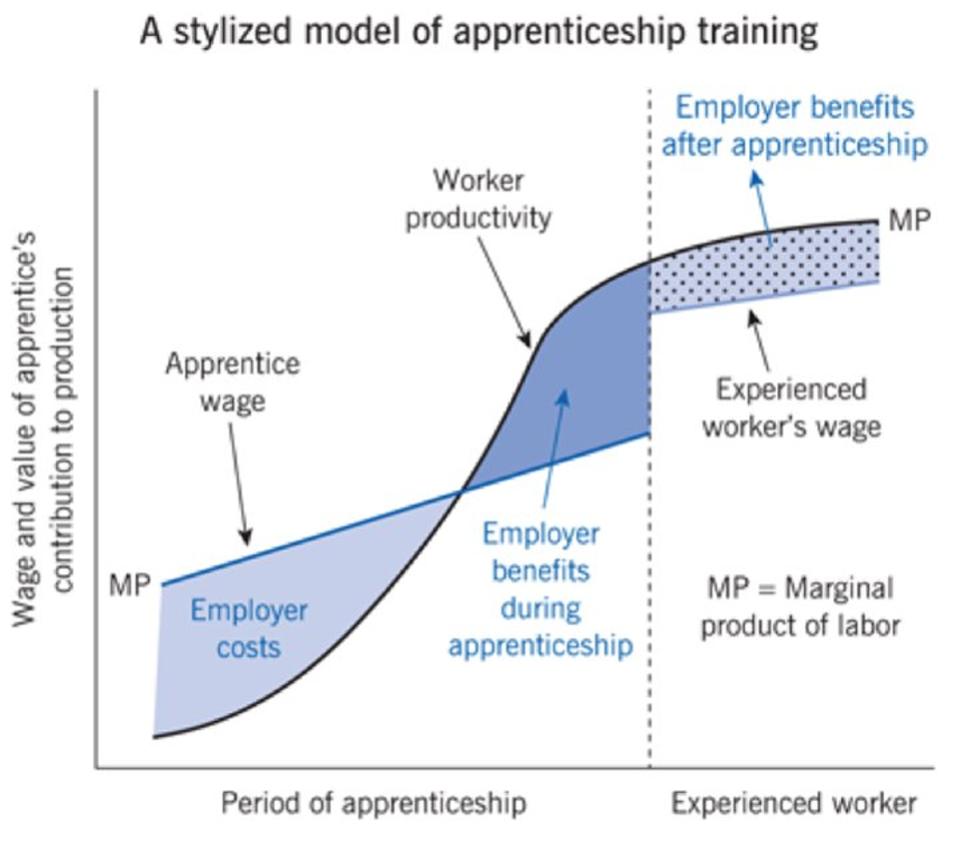
Nevertheless, independent researchers as well as individual companies have attempted to do so. In one study, European economists found the productivity of Swiss apprentices compared to skilled workers increased from 37% in the first year of training to 75% by the end of a three-year program. Their German counterparts advanced in productivity at roughly the same pace. Additionally, 60% of the Swiss firms recouped their costs during the training period, while the German firms, on average, required more time to break even (German apprentices spend more time than their Swiss counterparts in the classroom and practicing tasks.) But the point is that costs are recouped, and more quickly than many employers might realize.

Larger, more ambitious cost-benefit studies have been undertaken in Australia, Canada and the U.K. To summarize the key findings:

Figure 1

Source: Modified Figure Based On Gambin, L., C. Hasluck, and T. Hogarth. “Recouping the costs of Apprenticeship Training: Employer Case Study evidence from England.” Empirical Research in Vocational Education Training 2:2 (2010); 127-146.

·      Costs and benefits of apprentice training vary between nations, industries, and occupations. For example, in Canada, it costs roughly 3 ½ times more to train an electrician than to train a cook, which means it takes longer for employers training electricians to break even. 

·      Sponsoring companies either reach break-even within the training period itself or shortly thereafter. But they do break even and go on to positive gains. (See Figure 1).

The American experience

In contrast to Europe and Australia, U.S. firms are latecomers to apprenticeship. Nevertheless, an overwhelming majority of 900 employers surveyed said their programs produced net economic gains. Almost all reported that apprenticeship helps them meet their skill requirements and 87% said that they would strongly recommend registered apprenticeship to others. Only one in four regarded “poaching” of apprentice graduates as a serious concern. And even 85% of these would highly recommend apprenticeship to others.

Surveys and academic studies aside, common sense tells us that firms with decades of experience in apprenticeship—such as Siemens, Volkswagen and Newport News Industrial—would have abandoned apprentice training if it failed to produce net positive results. But they haven’t. On the contrary, these companies tout their apprentice systems. And when they set up operations in North America, one of the first things they do is create apprenticeship programs customized to their skill needs and local conditions, often in collaboration with local high schools and two-year colleges. They know from experience that program graduates will be skilled, productive and fully versed in workplace processes and protocols—“the way things get done around here”—in a way outside hires simply can’t be.

Employers with strong apprenticeship programs also benefit from reduced employee turnover and onboarding costs. Managers and supervisors have several years to observe their apprentices on-the-job and gauge their interpersonal skills before offering them official positions. And so their hiring decisions will be better than those who rely only on resumes and interviews and hope for the best.

Your choice 

So, if your company is short on skills, should you buy or build?

If you buy, you may be casting a line into a shallow pond that’s been mostly fished out. But if you build—by developing talent through a modern apprenticeship program—you’ll find yourself with a highly skilled and motivated workforce in just a few years. It may require more time and money upfront, but building can be the better strategy.

Forbes

Filed Under: Articles

‘Ready for a Career Change? Try Apprenticeship’ – Newsmax Finance

| November, 2019 | By Nicholas Wyman, CEO IWSI America |

There’s a model for success in life, right? You graduate from high school, go to college, get your degree, and find a great job using your newly acquired knowledge and skills. Cue happily ever after.

But wait a second. That scenario doesn’t seem like real life. Looking around, we see something different. We see people who can’t afford the escalating cost of a bachelor’s degree, or who can afford it only by incurring debt that will take years to repay. We see people who can’t get a job after they graduate, because there’s a mismatch between what they’ve learned in school and what employers require in the workplace. We see people changing careers often, and needing to acquire new skills.

Something must be wrong with our model. It’s definitely time for a new one.
And luckily, we have one right in front of us – one that’s worked for years in other prosperous economies and is now taking off in the U.S.: modern apprenticeship.

I say “modern” because when most people think of apprenticeships they imagine construction or skilled trades such as plumber or electrician. Yes, apprenticeships are common in those fields, and yes, they give you solid skills that can lead to a well-paying job. But modern apprenticeships encompass many more fields, including finance, healthcare, hospitality, green science and the tech sector. And employers who sponsor modern apprenticeships are often looking for a diversified workforce, including people who haven’t previously considered apprenticeship as a career path.

Let’s think about how apprenticeship can change the typical route from high school to college. I talked to one high-achieving student who did just that. With an outstanding GPA and high achievement test scores, Steve Blevins was on track for college. But that’s not what he wanted to do. Steve had always been interested in working with his hands, so while still in high school, he got a part-time job at Atlas.

After graduation, the company sponsored him in an apprenticeship program with the National Tooling and Machining Association.

To complete his three-year apprenticeship, Steve took courses in trigonometry, blueprint reading, shop math and programming, and other subjects relevant to his job requirements – 576 hours of classroom learning in all. He also received 8000 hours of on-the-job training. At the end, he had a nationally recognized credential, 50 credits toward an associate’s degree, and valuable work experience that included the “soft” skills – decision-making, collaboration, critical thinking – necessary for success in any workplace.

Transferable credentials and skills, a well-paid job and no student debt in three years – Steve’s story shows that modern apprenticeship is a viable path for any high school student who wants to get a head start in the workplace.

Apprenticeships also work well for people who want a change of career. Consider two young men in the Nike apprenticeship program: Hector Avalos and Victor Renderos. Each was engaged in employment or education before they started their apprenticeship – Hector working at an Amazon fulfillment center and Victor taking courses in early childhood education at a local community college — but both felt they needed a change.

After completing a pre-apprenticeship training course in coding, the two moved on to full apprenticeships as junior web developers at EasyKicks with Nike, where they’re thriving. Hector feels the apprenticeship has given him a career direction he was previously lacking. In particular, the mentoring component has opened him up to new possibilities and new ways of thinking. Says Hector, “I am learning to think outside the box, stretch my imagination, and collaborate to reach outcomes. At school, there was only one solution to every problem. Not here. This is super awesome.”

Victor has a similar story. The apprenticeship is giving him solid skills in a field he wasn’t sure he could master, as well as his first experience in a professional workplace. All of this while being paid.

These are only three of the many people who’ve gained career focus, technical skills and well-paying work through apprenticeships. Apprenticeships can work for people at any age, and any career stage. All that’s needed is a desire to advance and a commitment to learning new skills.

View Original Posting

Filed Under: Articles

Latest Report: ‘Skilling Up – The Scope of Modern Apprenticeship’

A collection of practical articles from the USA, Australia and the UK, co-edited by IWSI America, Urban Institute and the Commonwealth of Kentucky.

The collected chapters and vignettes address questions for businesses of all sizes, community-based organizations, and schools looking for a way to build strong pipelines of skilled labor, stimulate economies in struggling regions, provide options for adults seeking career changes, and stimulate engagement for students filled with curiosity about the promise of work-based learning. We endeavored to shatter myths, remove barriers, and erase fears of attempting apprenticeship, particularly for small and medium-size businesses and parents who are naturally concerned about meaningful and gainful career choices for their children. This reader intends to show the possibilities modern apprenticeship affords contemporary societies and to inspire many to reframe the boundaries of traditional thinking.

Read More:
https://www.urban.org/research/publication/skilling-scope-modern-apprenticeship

Download the Report

Filed Under: Articles

‘Workers ditch college, pick up skills through apprenticeships’ – Fox Business

IWSI America CEO and founder Nicholas Wyman discusses the importance of apprenticeships for young adults and workers looking for career change on Fox Business, November 20, 2019.

Watch On Fox Business

Filed Under: Video

  • « Go to Previous Page
  • Page 1
  • Page 2
  • Page 3
  • Page 4
  • Page 5
  • Interim pages omitted …
  • Page 7
  • Go to Next Page »

Footer

Publications

‘Job U: Find Your Path To A Successful Carer in a Tough Job Market’
by Nicholas Wyman

‘Job U – How to Find Wealth and Success by Developing the Skills Companies Actually Need‘  (US Edition) quickly shot to #1 on the Amazon Hot New Releases in Job Hunting and Career Guides. It has been awarded Best Business Careers book in the International Book Awards and won USA Best Book Awards, Business: Careers category.

Get ready to relearn everything you thought you knew about what a successful career path looks like.

Visit JOB U

  • WPC Group
  • NextGen Jobs
  • Shake a Leg
  • Connect

Copyright © 2026 IWSI Australia